What is virtual organizing and why should I try it?
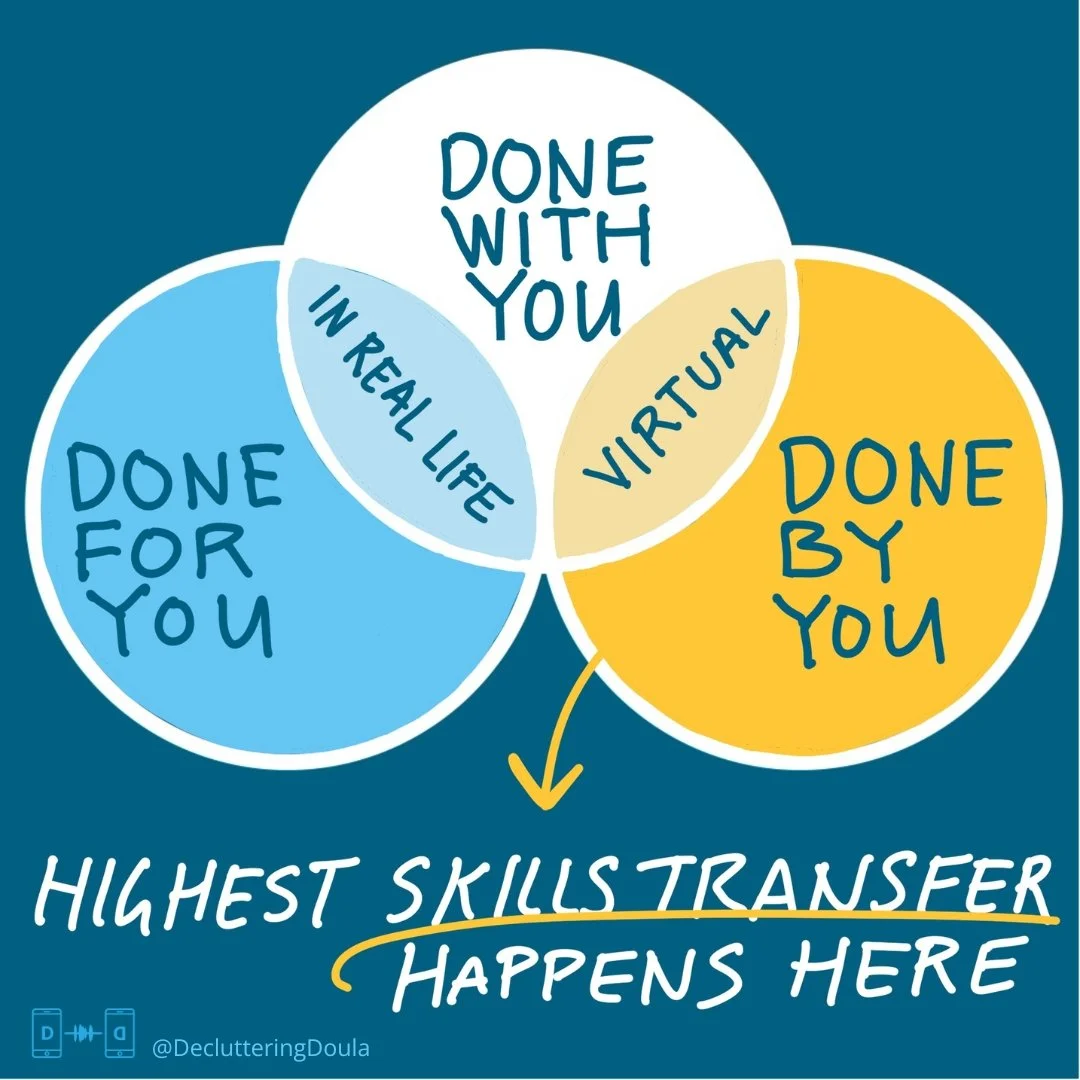
Virtual organizing utilizes a science-based, secret weapon for learning. Let’s talk about it!
Already familiar with Marie Kondo’s “Sparks Joy” method? Binged Netflix’s Home Edit series or gifted your parents a copy of Margareta Magnusson’s book, Swedish Death Cleaning: How to Free Yourself and Your Family from a Lifetime of Clutter?
The field of professional organizing has piqued your interest. Ever wondered how and if a professional organizer would work for you?
Let’s break down the three options to choose from when working with a professional organizer (PO). They are:
Done for you
Done with you, &
Done by you.
Let’s get into these three options in more detail:
Done for you
Done for you is what we see on the Netflix Home Edit show. You are present and involved through the visualizing and editing process then the home magically transforms while you are away for the day (or two).
Benefits of done for you include immediate gratification, and usually involve picture-worthy results, which can be hard to beat.
Cons of the done for you service can include the price tag (this is usually a more expensive option), needing to let a whole team of people into your home, and that you may not learn how to upkeep the system(s) put into place.
Have you ever cleaned your home before the cleaners come? When describing your wants/needs to the PO, there’s a good chance you may have been a tad aspirational.
Depending on your baseline knowledge and practice of organizing principles, if you didn’t work with the organizer on your habits and routines, new systems are installed but you may find that the systems break down in a few months.
Sure, a bin has been assigned for your (insert specific item here) but your routine ‘drop zone’ for those items wasn’t taken into consideration and you continue to drop (specific item) in another area instead of putting it the assigned-by-someone-else location.
Done with you
Done with you is where you are working with the organizer throughout the entire process.
The main benefits of done with you, beyond someone simply being there physically helping you move items, is that there is some transference of skill. In the above example of your current habit of a drop zone, you and the PO may make small alterations to slowly move the drop zone, step by step, to the new home or system for the items. Practicing together and addressing backsliding when it happens to see why and how you can change it. There tends to be more discussions and insights in the done with you process.
Cons of done with you service are that while you may have some immediate gratification, it may be on a smaller scale and a full home or larger space may take multiple sessions. There are usually hourly minimums, and you have to let someone into your home.
The rise of the third option for working with professional organizers ballooned with the pandemic: virtual organizing. (Not to be confused with digital organizing which is organizing your digital life, files, digital photographs, etc.)
Done by you:
Virtual Organizing (VO) is done by you.
VO uses all forms of digital communication platforms and predominantly video chat. The professional organizer provides in-real-time guidance and instruction via Zoom, Meets, FaceTime, etc. working in any area of your home or office (anywhere with good internet connection).
Benefits of done by you are: the sessions are shorter, have a narrower focus and therefore can happen more frequently. (VO works well for people with ADD/ADHD due to the shorter, more focused sessions. It’s an excellent platform for body doubling and also works well for people with kinesthetic and auditory learner styles.)
In VO sessions, you are the one moving through your own space and moving the objects. You are audibly receiving directions from the PO, talking out loud while doing the tasks (to yourself and the PO on the video call), then directions get repeated at the end of the session (wrap up) and how to move forward with the new system is discussed.
The information and instruction are delivered in multiple formats, you’ve physically and audibly engaged, notes from the session are provided, thereby hitting a few different learning styles… and that repetition is key.
Boom! More skills transfer and you can get more bang for your hard-earned buck with virtual organizing.
Wait, what? How?
Neuroplasticity is why the greatest skill transfer occurs in this done by you format. Neuroplasticity is the ability of the brain to change and learn new neural pathways due to experience. What fires together, wires together. (We’re talking synapses here).
Like James Clear’s habit stacking (the trick of stacking a newly desired habit to an already existing habit to help it stick), when you do something new a few times, the brain is malleable enough to learn it. Old habits get pruned (don’t use it, you lose it) as new ones gain traction with repetition.
Cons of done by you include: you need to be cognizant and capable of the physical labor, moving objects on your own (or have physical assistance when needed).
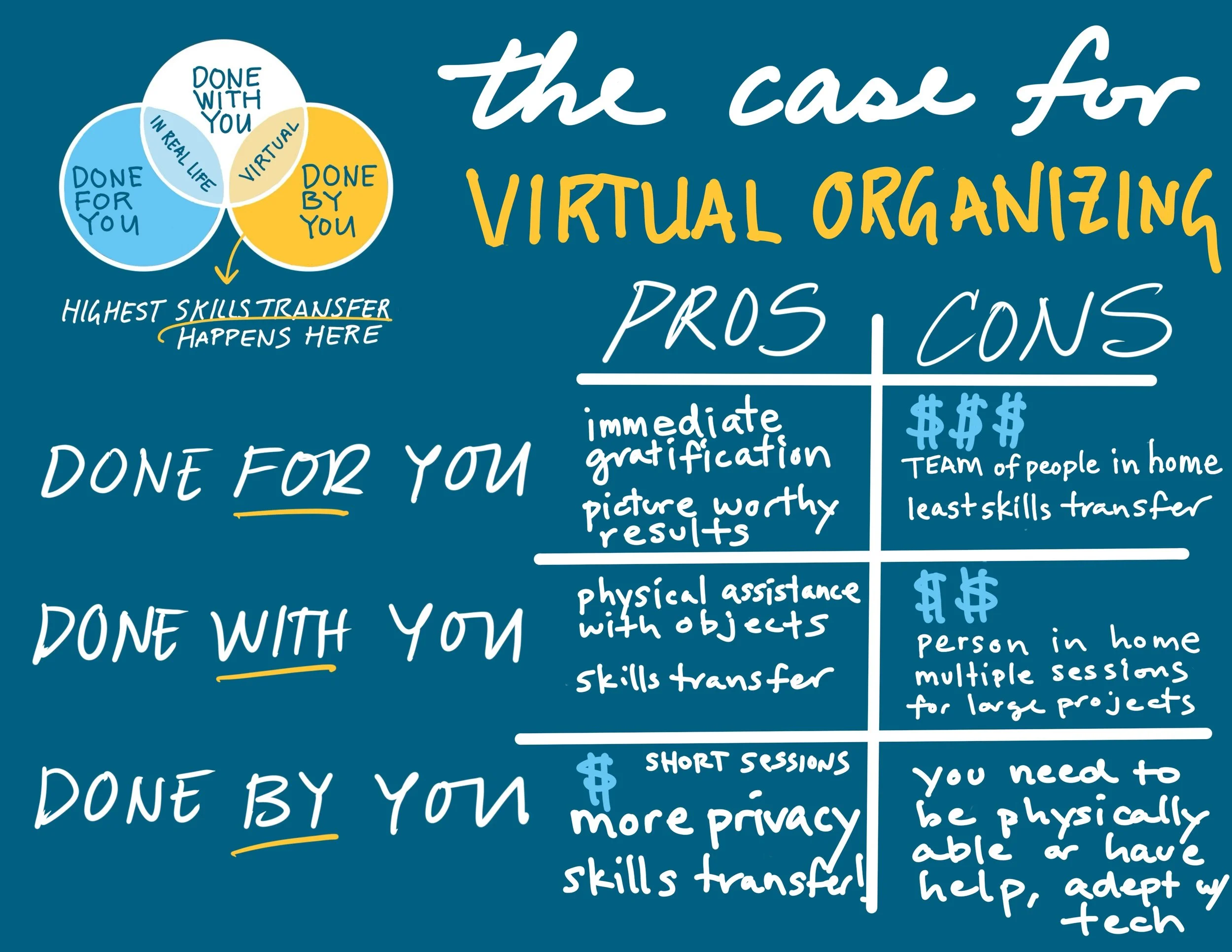
The three ways to work with a professional organizer with pros and cons for each.
Interested in trying VO and wondering where to find a virtual organizer? I offer a free consultation then one complimentary virtual session to see how and if virtual organizing would work for you.
Happy organizing!
You are enough and you have enough, I’m glad we’ve had this post!
Amy-Ellen